
Can a Trust Protect Too Much? (The Truth About Multigenerational Wealth)
A common concern that I hear from estate planning clients involves adult children and money.
Sometimes the concern is straightforward:
“My son is wonderful, but he has never really been good with money.”
Other times, it is more serious:
“My daughter makes impulsive financial decisions.”“I worry about divorce.”“I’m concerned about creditors.”“If my child received a large inheritance outright, I’m not sure it would end well.”
These are real concerns, and thoughtful parents are right to take them seriously.
For that reason, many clients naturally gravitate toward trusts with extensive restrictions and controls. They want to protect their children from financial mistakes, bad relationships, lawsuits, poor decisions, or simply the consequences of receiving too much money too quickly.
In estate planning circles, this sometimes results in what I privately think of as a “fortress trust.”
A fortress trust is built for maximum protection. Distributions are tightly controlled. Trustees are given broad authority. Beneficiaries may have limited access to principal for decades, sometimes even for life. The trust is designed to protect wealth from virtually every imaginable threat.
And in some families, this is exactly the right answer.
But increasingly, I find myself asking a different question: Can a trust protect too much? Is the fortress trust in some ways counterproductive?
It is an uncomfortable question because protection is generally viewed as a good thing. As estate planning attorneys, we spend much of our professional lives identifying risks and helping families guard against them. But there is a tension worth acknowledging.
Sometimes, the very tools designed to protect children financially can unintentionally undermine another important parental goal: raising highly functioning, independent adults.
Recently, I read about fascinating research by Gregory Clark, an economic historian who studied family wealth and social mobility over centuries. By tracking rare family surnames in England, Clark and other researchers reached a surprising conclusion: inherited wealth itself often dissipates much faster than many people assume. In some cases, the financial effects of inheritance became statistically insignificant by the grandchildren’s generation.
At first glance, this seems discouraging. Families spend enormous time and energy trying to preserve wealth across generations. But the more interesting finding came from Clark’s broader work on social status and family outcomes.
Something persisted across generations far more reliably than inherited dollars.
Family habits.
Financial culture.
Attitudes toward work, discipline, delayed gratification, risk, education, and decision-making.
In other words, what endured was not merely the inheritance.
It was what some people might call the family’s financial DNA.
Children appeared to absorb financial behaviors long before any inheritance arrived. Even in situations where parents died young, the broader family patterns often persisted. Whatever was being transferred across generations seemed to be learned through observation and environment as much as formal instruction.
That finding resonates deeply with what I see in practice.
Many parents understandably focus on protecting the inheritance itself. But I sometimes wonder whether the more important question is: How do we help our children become people capable of handling wealth?
A trust can protect assets.
A trust cannot create judgment.
A trust can slow down poor decisions.
A trust cannot substitute for financial maturity.
And a trust, by itself, cannot teach the habits that created wealth in the first place.
This is where the “fortress trust” deserves a second look.
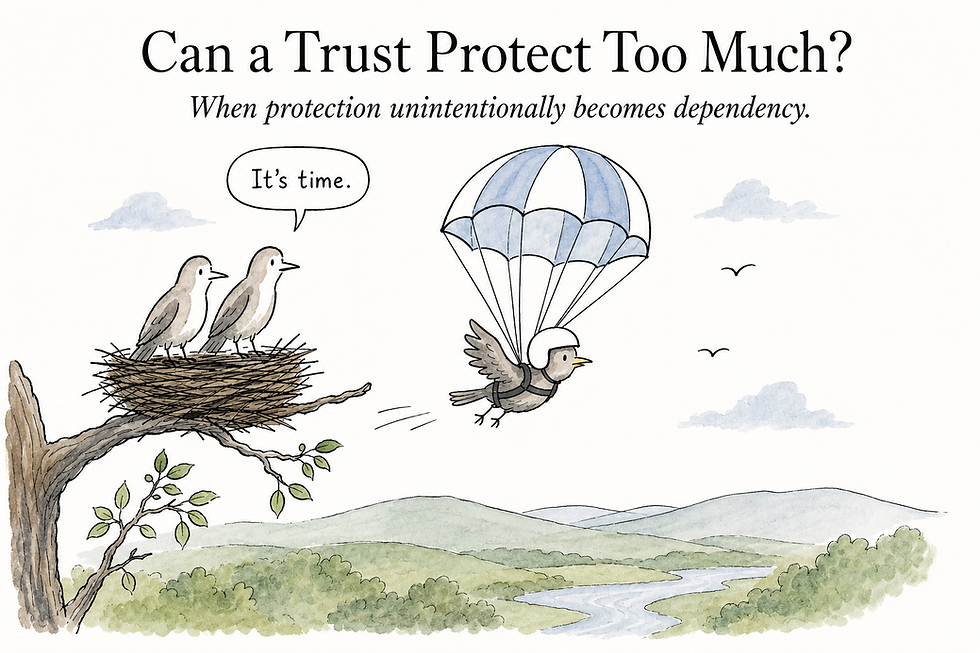
Imagine an adult child in their forties or fifties who must continually ask a trustee for permission to take a family vacation, replace a car, make a business investment, or help a grandchild with tuition. Even if the trustee is thoughtful and generous, the dynamic can begin to resemble dependence rather than stewardship.
The trust becomes less of a safety net and more of a financial parent.
To be clear, there are absolutely circumstances where strong restrictions are necessary. Addiction issues, creditor problems, unstable relationships, significant mental health concerns, disability, or long-standing financial irresponsibility may justify substantial guardrails. Some families truly need maximum protection, and there should be no shame in acknowledging that reality.
But for many families, I wonder whether the better question is not: “How do we maximize control?”
but instead: “How do we balance protection with independence?”
Increasingly, I think the best trust planning often lives somewhere in the middle.
Rather than imposing rigid restrictions forever, perhaps trusts should provide meaningful protection while gradually encouraging responsibility and autonomy.
That may mean broader standards for distributions focused on quality of life rather than narrow limitations. It may mean giving beneficiaries increasing authority as they age and demonstrate maturity. It may mean allowing adult children to eventually replace trustees, participate in investment decisions, or exercise greater control over portions of the trust.
Perhaps the goal is not permanent supervision.
Perhaps the goal is training wheels.
Because ultimately, the objective of parenting is not merely to protect children forever.
It is to help them become capable adults.
Ideally, an estate plan should reinforce that goal, not unintentionally work against it.
I sometimes tell clients that the most successful multigenerational families usually transfer more than money. They transfer habits. They transfer values. They transfer judgment. They teach children how financial decisions are made, why money matters, and how to think carefully about tradeoffs.
That kind of inheritance may ultimately matter more than the dollars themselves.
In the end, a trust may protect wealth. But financial education, modeling, and thoughtful conversations about money may be the things that actually sustain it.


Comments